
August 2026 - Product Guide - cannabis terpenes
Cannabis Terpenes Explained: How They Influence Flavor and Effects
Learn how cannabis terpenes influence flavor, aroma, and effects. Discover the most common terpenes and how they shape your cannabis experience.
By the MedLeaf Editorial Team ·
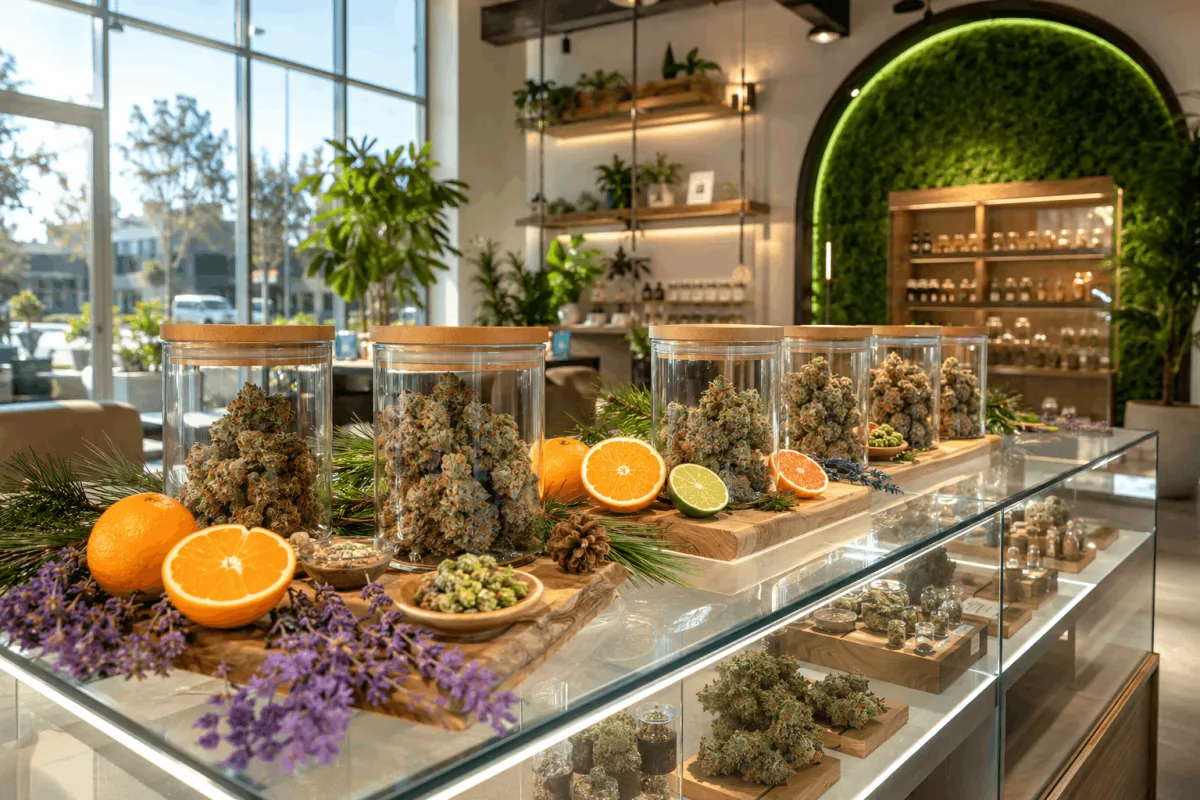
Cannabis Terpenes Explained: Chemistry, Aroma, and Heat
Introduction
Terpenes get named constantly on cannabis menus and explained almost nowhere. Most write-ups list five of them, attach a mood to each, and stop. That is enough to pick a strain, and if that is what you came for, the applied version lives in our guide to picking strains by terpene profile.
This is the reference version. What cannabis terpenes actually are as molecules, why the plant makes them at all, which ones show up and where else in nature they occur, what their boiling points mean for how you consume them, and what the entourage effect really is: a hypothesis with mixed evidence, not a settled fact. Nothing here is medical advice, and individual responses to cannabis vary enormously.
TLDR - Quick Guide
- Terpenes are hydrocarbons built from repeating five-carbon isoprene units. Monoterpenes have two units, sesquiterpenes have three and are heavier and less volatile.
- Cannabis makes terpenes and cannabinoids in the same glandular trichome heads, from a shared chemical precursor.
- Dried flower is typically only about one to three percent terpenes by weight, which is why the profile is fragile and easy to lose.
- Every terpene in cannabis also occurs elsewhere in nature. None of them are unique to the plant.
- Boiling points span a wide range, so combustion destroys most of the aroma while low-temperature vaporization preserves it.
- The entourage effect is a plausible hypothesis with genuinely mixed human evidence. Treat it as an open question, not a marketing fact.
Detailed Breakdown
What a Terpene Is, Chemically
Terpenes are a family of hydrocarbons assembled from a repeating five-carbon building block called isoprene. Count the units and you get the classes:
- Monoterpenes are two isoprene units, formula C10H16. Myrcene, limonene, pinene, terpinolene, and ocimene are all monoterpenes. They are small, light, and evaporate readily. They are most of what you smell when you open a jar.
- Sesquiterpenes are three isoprene units, formula C15H24. Caryophyllene and humulene are the common ones in cannabis. They are heavier, less volatile, and they linger after the bright top notes have burned off.
Strictly speaking, several compounds people call terpenes are terpenoids, meaning oxygen has been added to the structure. Linalool, bisabolol, and nerolidol are terpene alcohols. In everyday cannabis conversation the two words are used interchangeably, and that is fine, but the distinction is real and it changes how the molecule behaves.
Why the Plant Makes Them at All
Terpenes are not made for your benefit. In plants generally they are defensive and signaling chemistry: deterring insects and grazing animals, discouraging fungal and bacterial growth, and in some species attracting pollinators. Cannabis concentrates them in the same place it concentrates cannabinoids, in the resin heads of the capitate-stalked glandular trichomes coating the flower.
The two are not just neighbors, they share a supply line. Geranyl pyrophosphate is the precursor the plant uses to build monoterpenes, and it is also one of the two inputs condensed to build CBGA, the acid cannabinoid everything else in the cannabinoid pathway descends from. Both pathways draw on the same chemical pool, which is one reason the two profiles tend to move together across cultivars rather than independently.
Scale is usually left out. Dried flower is commonly around one to three percent total terpenes by weight, against fifteen to twenty-five percent or more cannabinoids. Terpenes are a trace component, which is exactly why they are so easy to lose in handling and why the aroma of one cultivar varies so much between producers.
The Major Terpenes, One at a Time
Cannabis has been reported to contain well over a hundred terpenes, but a short list dominates in practice. Below is each one with its aroma, where else in nature it turns up, and its approximate boiling point at ordinary atmospheric pressure.
Myrcene
Earthy, herbal, musky, slightly clove-like. Frequently the single most abundant terpene in a cannabis sample. Elsewhere in nature it is a major component of hops, and it also appears in lemongrass, thyme, bay leaf, and mango. Boiling point roughly 167 degrees Celsius, about 332 Fahrenheit. It is a monoterpene, and the popular folklore about eating a mango before consuming cannabis to intensify effects has no good human evidence behind it.
Limonene
Bright, sharp citrus. It is the compound that makes citrus peel smell like citrus, and it is also present in juniper and peppermint. It is used industrially as a solvent and a cleaning agent, which tells you something about how volatile and reactive it is. Boiling point roughly 176 degrees Celsius, about 349 Fahrenheit.
Alpha-Pinene
Pine resin, sharp and clean. Found in conifers, rosemary, basil, dill, and parsley. It is one of the most widely distributed terpenes on earth and a major contributor to forest air. Boiling point roughly 155 degrees Celsius, about 311 Fahrenheit, which makes it the lightest of the common cannabis terpenes and the first one you lose to heat and time.
Terpinolene
Harder to pin down than the others. Floral and herbal with a fresh, faintly apple or lilac edge. Found in nutmeg, cumin, apples, lilac, and tea tree. It is less common than myrcene or limonene as a dominant terpene, so cultivars where it leads tend to smell distinctly unlike everything else on a menu. Boiling point roughly 186 degrees Celsius, about 366 Fahrenheit.
Linalool
Floral, soft, unmistakably lavender. Also present in coriander, birch bark, and many flowers. It is a terpene alcohol rather than a plain hydrocarbon, and it usually shows up in cannabis at lower concentrations than myrcene or limonene while still being easy to smell. Boiling point roughly 198 degrees Celsius, about 388 Fahrenheit.
Beta-Caryophyllene
Black pepper and warm spice. Found in black pepper, clove, cinnamon, and hops. It is the most pharmacologically interesting terpene in cannabis because it is the exception to the rule: research published in 2008 identified it as a selective agonist at the CB2 cannabinoid receptor, meaning it binds a cannabinoid receptor directly despite not being a cannabinoid. CB2 activation does not produce THC-like intoxication, which is CB1-mediated, so this does not make caryophyllene intoxicating.
Humulene
Hoppy, woody, a little bitter. It is chemically a close relative of caryophyllene and is named for Humulus lupulus, the hop plant. Also found in sage and ginseng.
The Quieter Ones
Ocimene brings a sweet herbal note and occurs in mint, parsley, and orchids. Bisabolol is soft and faintly sweet, and is the compound behind the smell of chamomile. Nerolidol is woody and floral, and appears in jasmine, ginger, and tea tree. All three turn up in cannabis lab reports regularly, usually as minor components that shape a profile rather than define it.
Boiling Points, and What They Actually Tell You
Boiling point charts circulate constantly in cannabis content, and most are quietly wrong in a specific way worth knowing about.
The monoterpene figures above are honest atmospheric-pressure values clustering between roughly 155 and 200 degrees Celsius. The sesquiterpenes are the problem. You will frequently see beta-caryophyllene listed at 119 degrees Celsius and humulene at 106. Those come from laboratory distillation under strong vacuum, where reduced pressure lowers boiling point dramatically. At the atmospheric pressure you actually vaporize in, beta-caryophyllene boils around 262 degrees Celsius, roughly 504 Fahrenheit. Any chart placing a sesquiterpene below a monoterpene has mixed vacuum figures in with atmospheric ones.
The practical consequences are straightforward:
- Combustion obliterates the profile. The burning tip of a joint runs several hundred degrees above the boiling point of every compound on this list. The terpenes you smell in the smoke are the ones escaping ahead of the ember, not the ones delivered intact.
- Low-temperature vaporization is the flavor-preserving option. Dry herb vaporizers commonly operate somewhere in the range of 175 to 210 degrees Celsius, which sits above most monoterpenes and below combustion. Start at the low end of a device's range and the first draws are dominated by the light, bright terpenes. Raise the temperature through a session and the profile shifts heavier as sesquiterpenes come off.
- Terpenes leave on their own, slowly. Volatility is not only about deliberate heating. Warmth, light, oxygen, and time all strip terpenes from stored flower. A jar that smelled loud in September and flat in December did not lose its cannabinoids, it lost its top notes. Cool, dark, sealed, and reasonably airtight is the whole storage strategy.
The same physics explains a category difference on the menu. Distillate is stripped of terpenes during refinement, so terpenes are added back afterward, either cannabis-derived or botanically sourced. Live resin and similar fresh-frozen extracts are made to retain the plant's native profile instead. If terpene character is what you are shopping for, that distinction matters more than the potency figure printed next to it. Our comparison of flower against vape formats goes further into the trade-off.
The Entourage Effect, Stated Honestly
The entourage effect is the hypothesis that cannabis compounds produce different results together than any of them produce alone, and that terpenes are part of why.
The term was coined in 1998 by Ben-Shabat and Mechoulam, originally describing compounds the human body produces rather than plant chemistry. It was extended to cannabis terpenes most influentially by Ethan Russo in a 2011 review proposing specific cannabinoid and terpene synergies and calling for research to test them. Nearly all consumer-facing entourage talk traces back to that paper, which framed its content as testable proposals rather than findings.
Fifteen years on, the evidence is genuinely mixed:
- A 2020 pharmacology study tested common cannabis terpenes directly at CB1 and CB2 receptors and concluded they did not act at those receptors even at 10 micromolar, far above any concentration reachable in the body, arguing against the most literal version of the mechanism.
- A 2021 animal study reported that several terpenes produced cannabinoid-like behavioral effects in mice and added to the effect of a cannabinoid receptor agonist, which supports some form of interaction.
- Beta-caryophyllene binding CB2 is well documented and is the clearest single point in favor of terpenes having direct receptor activity.
- Controlled human studies attempting to show that adding terpenes changes the subjective experience of THC have been small and inconsistent.
A fair reading is this: something real is probably going on, the mechanism is not established, and the confident claims made on packaging and in marketing copy run far ahead of the science. Aroma preference is a legitimate reason to buy a product. A promised outcome is not, and no terpene treats, cures, or manages any condition.
Reading a Terpene Report Without Fooling Yourself
California requires cannabis batches to be lab tested before retail sale, and many producers publish terpene results alongside cannabinoid results. Four things to keep in mind. Total terpene percentage is a rough quality signal rather than a mood signal, with a figure toward the high end of the typical range usually indicating well-grown and well-stored material. Rank order beats absolute numbers, because which two terpenes lead is more comparable across labs than any single decimal. The report describes the batch at test time, so a pack date months in the past means the printed profile is optimistic. And a profile is not a prediction, since dose, tolerance, setting, and body chemistry all move the outcome further than a terpene decimal does.
Our guide to reading a menu listing and its lab results covers the rest of the certificate. For why the potency figure on the same label deserves far less trust than it gets, see what the THC percentage actually measures. Current lab-tested inventory is on the MedLeaf menu.
Key Takeaways
- Terpenes are isoprene-based hydrocarbons. Monoterpenes are light and volatile, sesquiterpenes are heavier and persist longer.
- Cannabis builds terpenes and cannabinoids in the same trichome heads from a shared precursor, which is why the two profiles track each other.
- Terpenes are a trace fraction of dried flower by weight, so the profile is fragile and degrades with heat, light, oxygen, and time.
- Every cannabis terpene occurs elsewhere in nature, from hops and citrus peel to black pepper, lavender, and chamomile.
- Monoterpenes boil roughly between 155 and 200 degrees Celsius. Widely circulated sub-120 figures for caryophyllene and humulene are vacuum values, not atmospheric ones.
- The entourage effect remains an unresolved hypothesis with evidence on both sides, and beta-caryophyllene binding CB2 is its strongest documented data point.
FAQs
1. What are terpenes made of?
Terpenes are hydrocarbons assembled from repeating five-carbon isoprene units. Two units make a monoterpene such as myrcene or limonene, and three make a sesquiterpene such as caryophyllene. Versions containing oxygen, including linalool and bisabolol, are more precisely called terpenoids.
2. Are terpenes unique to cannabis?
No. Every terpene found in cannabis occurs elsewhere in the plant world, often in far higher concentrations. Myrcene is abundant in hops, limonene defines citrus peel, pinene is a major component of conifer resin, and caryophyllene is what makes black pepper smell peppery.
3. What temperature should I vaporize at to preserve terpenes?
Most cannabis monoterpenes boil between roughly 155 and 200 degrees Celsius, so dry herb vaporizers are commonly used somewhere in the 175 to 210 range. Starting low favors the light, bright aromatic compounds, and increasing temperature through a session brings out heavier ones. Combustion runs hundreds of degrees hotter and destroys most of the profile.
4. Is the entourage effect real?
It is an open scientific question rather than an established fact. The idea was proposed in 1998 and extended to cannabis terpenes in a 2011 review, and testing since then has produced conflicting results, with some studies finding no terpene activity at cannabinoid receptors and others finding cannabinoid-like effects in animals. Beta-caryophyllene binding the CB2 receptor is the clearest confirmed example of a terpene acting directly.
5. Why does my flower smell weaker than when I bought it?
Terpenes are volatile and make up only a small fraction of flower by weight, so they escape steadily when exposed to warmth, light, or air. The cannabinoid content is far more stable, which is why old flower can still be potent while smelling and tasting flat. Storing it sealed, cool, and out of light slows the loss considerably.
More from August 2026
Order weed delivery near you
MedLeaf delivers licensed, lab-tested cannabis across North County San Diego and Southwest Riverside County. Pick your city to see local delivery details, or browse the live menu.
- Weed delivery in Oceanside
- Weed delivery in Carlsbad
- Weed delivery in Encinitas
- Weed delivery in San Marcos
- Weed delivery in Vista
- Weed delivery in Escondido
- Weed delivery in Fallbrook
- Weed delivery in Bonsall
- Weed delivery in Temecula
- Weed delivery in Murrieta
- Weed delivery in Solana Beach
- Weed delivery in Del Mar
- Weed delivery in Poway