
September 2026 - Vapes / Comparison - vape pods vs cartridges
Vape Pods vs Cartridges: What's the Difference and Which Should You Choose?
Compare vape pods vs cartridges, including compatibility, convenience, cost, hardware, and portability, to find the cannabis vape format for you.
By the MedLeaf Editorial Team ·
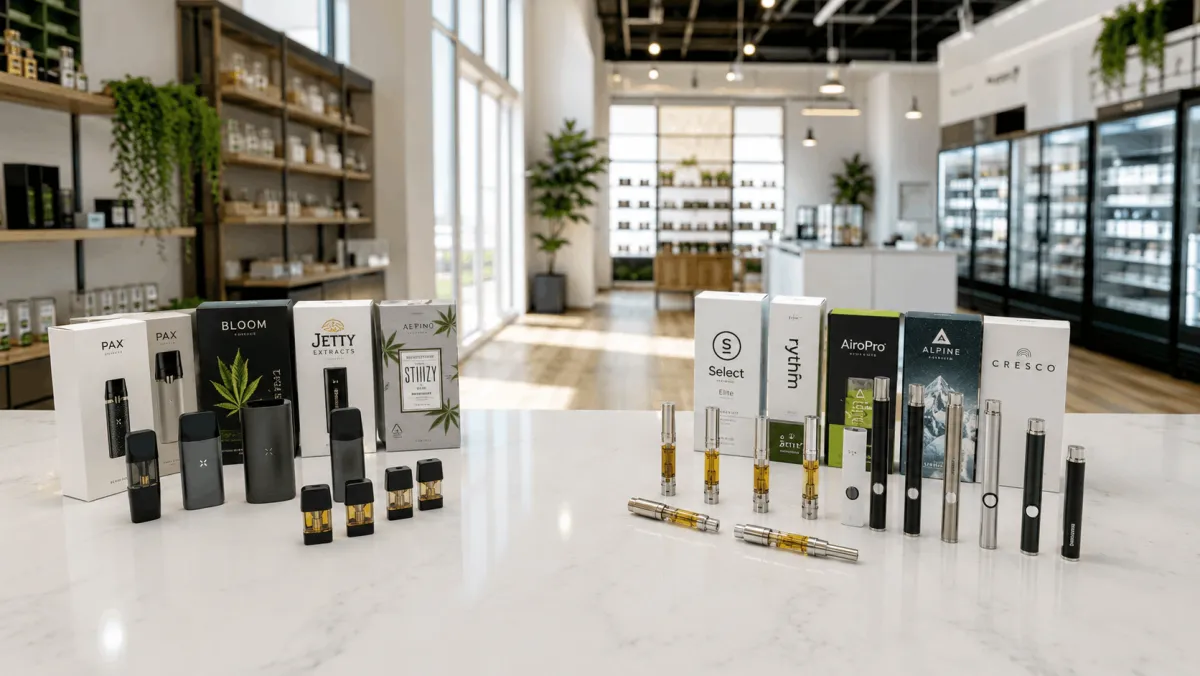
Vape Pods vs Cartridges: A Compatibility Guide
The useful question about vape pods vs cartridges is not which one contains better oil. Both contain cannabis concentrate and the format tells you nothing about the quality of what is inside.
The useful question is mechanical: what will physically connect to the battery you own, or the battery you are about to buy, and what does that decision commit you to afterward?
Cartridges mostly use a shared threaded connector that many manufacturers build to. Pods mostly use a connector designed by one brand for its own battery. That single difference determines whether your next oil purchase is chosen from the whole menu or from one brand's section of it. This guide covers how the 510 thread works, why it guarantees less than people assume, what proprietary pod lock-in actually costs, how to match voltage to the oil you are running, and how to tell what a device accepts before you spend money on oil for it.
TL;DR - Quick Guide
- The 510 thread is a near-universal mechanical standard for cannabis cartridges. Most carts and most reusable batteries use it.
- It is a mechanical standard, not an electrical one. It guarantees the cart screws on, not that the battery heats it well.
- Proprietary pods use magnetic, keyed, or clip connectors designed for one brand's battery. Nothing else fits.
- The cost of lock-in is your future menu. Out of stock, discontinued, or on promotion elsewhere all become your problem.
- What lock-in buys is a matched pair. The maker tuned the voltage to their own oil, which reduces clogging and burning.
- Thin distillate wants lower voltage. Thicker live resin and rosin want more heat or a preheat cycle.
- Before buying oil, identify the connector: visible threads, a magnet, or a slot. Check the listing for the words 510 thread, and check whether the pod names a specific battery.
- Center-pin height and thread depth are the two mechanical faults behind most 510 cartridges that will not fire.
The 510 Thread: What It Guarantees
Where the standard came from
The 510 thread is a screw connector borrowed from early electronic cigarette hardware; the name is generally traced to a design using ten threads at half-millimeter pitch. It was never a cannabis standard and no cannabis regulator defined it. It became the default because enough manufacturers built to it that building anything else meant selling into a smaller pool of batteries.
The practical result is unusually good for buyers. Cartridges from many different producers screw onto batteries from many different producers, and you can change brand of oil without changing hardware. Very few consumer categories work that way.
What it does not guarantee
Here is the part that trips people up. The 510 spec describes a thread. It says nothing about voltage, wattage, coil resistance, airflow, or heat curve.
So two batteries that both accept the same cartridge can produce completely different results from it. One may run the coil hot enough to scorch a delicate live resin; another may run it too cool to properly vaporize a thick extract, leaving you with weak draws and eventually a clog. Both connected correctly. Both 510.
Compatibility, in the sense that matters, is fit plus appropriate power. The thread only covers the first half.
The two mechanical faults that stop a 510 cart from firing
When a correctly threaded cartridge does not work, the cause is usually one of two things, and both are fixable.
- Center pin height. Contact is made by a small pin in the base of the cartridge touching a contact in the battery. If the cartridge is screwed down too tightly, the pin can be pushed flush and lose contact. Backing the cartridge off a quarter turn often restores it.
- Thread depth. Not every manufacturer cuts the threads to the same depth. A cart can bottom out before its pin reaches the contact, or sit proud in a way that never seats. This is why one cartridge brand works perfectly on a battery that a different brand refuses to fire on.
Neither fault means the cartridge or the battery is broken. It means the pairing is marginal, and it is worth knowing before you conclude you bought a bad product.
Proprietary Pod Systems: What Lock-In Costs
How pods connect
A pod is oil in a housing designed to attach to one specific battery platform, usually by magnet, by a keyed slot, or by a positive click. Some systems add electronic authentication so the battery only fires a pod it recognizes. The engineering intent is a matched pair rather than an open standard.
STIIIZY is the clearest California example of this approach, having built its reputation on a dedicated pod-and-battery system rather than the conventional 510 route. If you are weighing that specific ecosystem, our STIIIZY vape review looks at the products themselves.
The costs are all about your next purchase, not this one
Buying into a pod system feels free on the day you do it. The costs arrive later.
- Your oil menu shrinks to one producer. Whatever else is available, in whatever extract type, at whatever price, is not an option without buying a second battery.
- Stock outages become dead ends. With a 510 battery, a brand being unavailable means choosing a different brand. With a pod battery it means not buying anything.
- Promotions elsewhere are unusable. A strong deal on another producer's cartridges is worth nothing to you.
- Format risk sits with you. If the manufacturer changes or retires the pod design, the battery becomes hardware with nothing to run on it.
- Replacement is single-source. A lost or failed battery has exactly one replacement path.
What lock-in buys
It is not nothing, and it is worth stating plainly.
The maker of a closed system knows exactly what oil the battery will heat, and can set the voltage and heat curve for that specific viscosity. That removes the mismatch problem entirely. Connections are usually more secure than a thread, with less leaking and no risk of cross-threading. And the fit question disappears, which for some buyers is the entire appeal.
A closed system is a reasonable choice for someone who has settled on one producer and buys from them repeatedly. It is a poor choice for anyone who likes to compare.
Matching the Battery to the Oil
If you go the 510 route, this is the skill that replaces the compatibility guarantee a pod system gives you.
Voltage and viscosity
Thin oils vaporize at lower temperatures. Thicker ones need more energy to move and vaporize. Running a thin distillate at high voltage tends to produce a harsh, burnt-tasting draw and burns through the oil faster. Running a thick live resin or rosin at low voltage produces weak vapor and lets residue accumulate, which is how clogs start.
Most variable-voltage batteries offer three or four settings. The practical approach is to start at the lowest, take a draw, and step up only if the vapor is thin. It is far easier to add heat than to recover from a scorched coil.
Preheat
A preheat function runs the coil at low power for a few seconds without a draw, loosening thick oil before you inhale. It matters most with viscous extracts and in cold weather, and it is the feature most likely to prevent a clog. If you plan to buy live resin or rosin cartridges, buy a battery that has it.
Cartridge resistance
Cartridges vary in coil resistance, which changes how much power a given voltage delivers. You rarely see this specified on a cannabis product listing, which is another argument for starting at the lowest voltage setting on any new cartridge rather than assuming last cartridge's setting carries over.
How to Tell What a Device Accepts Before You Buy Oil for It
Do this in order. It takes under a minute and it prevents the most annoying purchase mistake in the category.
- Look at the connector. Visible screw threads in a recessed well means 510. A flat face with a magnet or a rectangular slot means a proprietary pod system.
- Read the listing for the words 510 thread. Batteries that use the standard almost always advertise it, because broad compatibility is the selling point.
- Read the pod listing for a named battery. A proprietary pod will name the system it belongs to. If it names a brand rather than a standard, assume it fits only that brand.
- Watch for a hybrid. Some pod-shaped devices are housings that take an ordinary 510 cartridge inside them. Shape alone does not tell you which you are holding.
- Check for authentication. If a system advertises chipped or authenticated pods, treat third-party compatibility as impossible rather than uncertain.
- Ask before you buy the oil. On a delivery menu the product page is your only source, so read the hardware description before adding a cartridge for a battery you have not confirmed.
A note on adapters
Adapters that claim to bridge proprietary pods onto standard batteries exist. They are worth approaching with caution: they can seat poorly, produce intermittent contact, and defeat the voltage matching the pod system was built around. If a manufacturer does not state that a pairing is supported, the safe assumption is that it is not.
Which Should You Choose?
Three questions settle it.
- Do you already own a battery? If it is a 510, buying pods means buying a second battery. If it is a pod battery, buying a 510 cartridge means the same. The hardware you own has already answered part of this.
- Do you buy from one producer or many? One producer, consistently, and a pod system costs you nothing. Several, or whoever has the best price this week, and lock-in is a real ongoing cost.
- What are you running? Thin distillate is forgiving on almost any hardware. Thick live resin or rosin rewards a battery with preheat and adjustable voltage, which is easier to find in the 510 world. Our comparison of live resin versus distillate cartridges covers what those oils are.
If none of this appeals and you would rather skip hardware entirely, the sealed integrated format removes the question at a price; see whether an all-in-one is worth buying for that arithmetic. If you want to know how long a given cartridge should last you, read how long vape carts last.
Browse current cartridges, pods, and batteries at the MedLeaf menu. MedLeaf delivers under California license C12-0000589-LIC across San Diego and Riverside counties.
Key Takeaways
- The vape pods vs cartridges decision is a hardware compatibility decision, not a quality one. Neither format says anything about the oil.
- The 510 thread is a near-universal mechanical standard, which is why one battery can run cartridges from many producers.
- It standardizes the thread only. Voltage, coil resistance, and heat curve are not covered, so fit does not guarantee good performance.
- Most 510 cartridges that will not fire are suffering from a depressed center pin or a thread depth mismatch, not a defect.
- Proprietary pods trade your future menu for a guaranteed fit and factory-matched voltage.
- Lock-in costs show up later: outages, promotions you cannot use, and a battery tied to one producer's continued support.
- Match heat to viscosity. Start low with any new cartridge and buy a preheat function if you run thick extracts.
- Identify the connector and read the listing for the words 510 thread before buying oil for any device.
FAQs
1. What is a 510 thread and why does it matter?
It is a screw connector borrowed from early electronic cigarette hardware that became the default for cannabis vape cartridges, so most carts and most reusable batteries can be mixed and matched. It matters because it is the difference between choosing oil from the whole menu and choosing it from one brand's section. It is a mechanical standard only, and does not standardize voltage or heating.
2. Can a vape pod work on a 510 battery?
Generally no. Proprietary pods use magnetic, keyed, or clip connections designed for one manufacturer's battery, and some add electronic authentication that prevents anything else from firing them. Unless the maker explicitly states compatibility, assume the pod fits only its own system.
3. My cartridge screws on but will not fire. What is wrong?
Most often the center pin in the base of the cartridge has been pushed flush by overtightening, breaking contact with the battery. Unscrew it a quarter turn and try again. The other common cause is a thread depth mismatch between that particular cartridge brand and that particular battery, which is a pairing problem rather than a fault in either part.
4. What voltage should I use for a cannabis cartridge?
Start at the lowest setting your battery offers and step up only if the vapor is too thin. Thin distillate vaporizes at lower temperatures and scorches easily at high voltage; thicker live resin and rosin need more heat, and benefit from a preheat function that loosens the oil before you draw. Cartridge coil resistance varies and is rarely published, which is why the lowest setting is the safe starting point for anything new.
5. Are cartridges or pods better value over time?
Cartridges usually give you more room to shop, since a 510 battery lets you buy whoever is priced best that week, while a pod battery ties future purchases to one producer. That flexibility is worth more the more often you buy. The full cost comparison between reusable hardware and sealed integrated devices is covered in our guide to whether an all-in-one vape is worth buying.
More from September 2026
Order weed delivery near you
MedLeaf delivers licensed, lab-tested cannabis across North County San Diego and Southwest Riverside County. Pick your city to see local delivery details, or browse the live menu.
- Weed delivery in Oceanside
- Weed delivery in Carlsbad
- Weed delivery in Encinitas
- Weed delivery in San Marcos
- Weed delivery in Vista
- Weed delivery in Escondido
- Weed delivery in Fallbrook
- Weed delivery in Bonsall
- Weed delivery in Temecula
- Weed delivery in Murrieta
- Weed delivery in Solana Beach
- Weed delivery in Del Mar
- Weed delivery in Poway