
July 2026 - Product Comparison - live resin carts vs distillate carts
Live Resin Carts vs Distillate Carts: Which Delivers a Better Experience?
Compare live resin carts vs distillate carts to learn which offers better flavor, effects, potency, and value for cannabis consumers.
By the MedLeaf Editorial Team ·
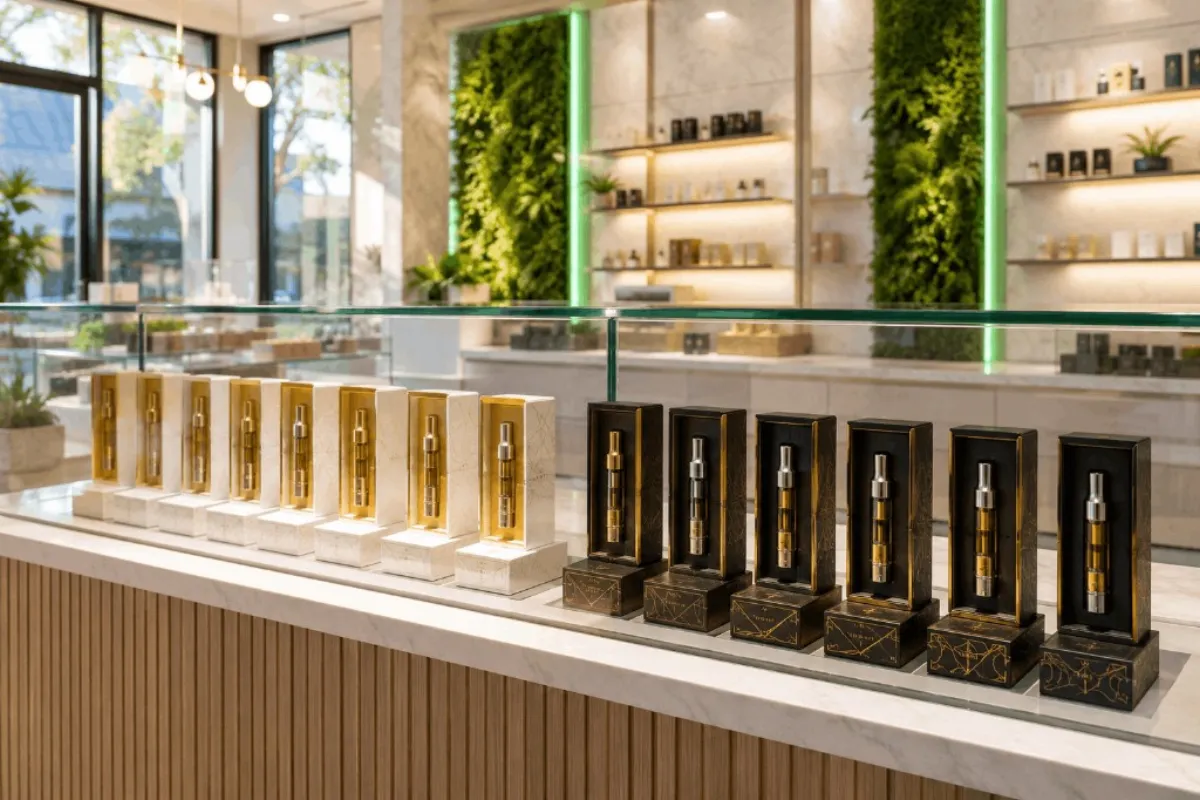
Live Resin Carts vs Distillate Carts: What Is Actually Inside the Tank
Put a live resin cart and a distillate cart side by side and the hardware is often identical - same 510 thread, same glass tank, same ceramic coil, same half-gram or gram fill. The price is not identical, and neither is the experience. All of that difference sits in the oil.
These are two genuinely different fills. One is a refined, near-pure cannabinoid oil that arrives at the filling stage with essentially no smell, then has flavor built back into it. The other is an extract that carries the plant's own aromatic compounds through to the tank and never had them removed. Understanding which one you are holding explains the flavor, the price, the THC number on the box, and why one of them clogs in a cold car.
This guide is about cartridges only. For the extraction methods behind these oils, see live resin vs rosin. For jarred concentrates and dabbing textures, see our guide to choosing concentrates by texture.
TLDR - Quick Guide
- Distillate is cannabis extract refined down to almost pure cannabinoid - typically 85 to 95 percent - with the aroma stripped out.
- Because refining removes the smell, terpenes are added back in afterward to create flavor and to thin the oil.
- Those added terpenes can be botanical, sourced from other plants, or cannabis-derived. The label usually says which.
- Live resin fill is full-spectrum: the terpenes were never removed, so the flavor is the plant's own.
- Live resin carts test lower in THC, often 65 to 85 percent, because terpenes occupy mass that would otherwise be cannabinoid.
- Lower THC on a live resin cart is not weakness. It is the terpene fraction showing up in the math.
- Distillate costs less because refining works with cheaper input and produces more sellable oil per pound.
- Viscosity differs: live resin is more mobile and more likely to clog in cold weather; thin distillate is more likely to seep in heat.
- Check the total terpene percentage on the label, not just the THC percentage. It is the number that predicts flavor.
- Strain names on a distillate cart describe a flavor formulation, not necessarily the cultivar the oil came from.
What Distillate Actually Is
Distillate is the product of a refining step that happens after extraction. Crude cannabis extract goes through distillation, where the mixture is heated under deep vacuum so its components boil off at different temperatures and can be collected separately. Because the pressure is so low, cannabinoids vaporize well below the temperature that would destroy them.
The point of the exercise is separation. Run the process and you can pull off a fraction that is overwhelmingly one cannabinoid, leaving behind fats, waxes, pigments, and residual plant material. Repeat the pass and it gets purer still.
The result is a clear to pale amber oil that is 85 to 95 percent cannabinoid by weight and looks like honey. It has almost no smell and almost no taste. Terpenes are lighter and more volatile than cannabinoids, so they come off in an earlier fraction and are not part of what is collected. Whatever aroma the original plant had is gone by design.
That neutrality is the commercial appeal. Distillate is a predictable, standardized input. A manufacturer can buy it, know exactly what it contains, and formulate around it without worrying about batch-to-batch variation in smell.
Why Something Has to Be Added Back
Pure distillate makes a poor cartridge fill on its own for two independent reasons.
The first is flavor. An odorless, tasteless oil produces vapor that tastes vaguely of nothing, and nobody buys that twice.
The second is physical. Distillate at room temperature is extremely thick - closer to cold molasses than to oil. In a cartridge that thickness is a real engineering problem, because the fill has to wick from the tank into the coil at a usable rate. Too thick and the cart starves, draws hard, and burns.
Terpenes solve both problems at once. They are aromatic and they are thin, so adding a small percentage back both creates a flavor profile and cuts the viscosity to something a wick can move. This is why essentially every distillate cart on the market is distillate plus something, and why the something is nearly always terpenes.
Botanical Terpenes vs Cannabis-Derived Terpenes
Terpenes are not unique to cannabis. Limonene occurs in citrus peel, pinene in conifers, linalool in lavender, myrcene in hops and mango. A terpene molecule from an orange is the same molecule as one from a cannabis plant.
Botanical terpenes are sourced from those other plants, or produced synthetically, and blended to a recipe. They are cheap, consistent, and available in unlimited quantity, and a skilled formulator can build a convincing profile with them. What they cannot do is reproduce the full complexity of a specific cultivar, because a real cannabis terpene profile contains dozens of compounds at particular ratios, including minor ones nobody bottles individually.
Cannabis-derived terpenes are recovered from cannabis itself, usually captured during extraction. They cost far more, are limited by supply, and are the reason some distillate carts carry a premium price. A cart formulated with cannabis-derived terpenes tastes noticeably more like cannabis than one built from a botanical blend.
Look for wording on the box. Cannabis-derived terpenes are a selling point, so brands that use them say so. Where the label only says terpenes, or says natural flavors, assume botanical.
This is also why a strain name on a distillate cart deserves a skeptical read. It often describes a flavor formulation - a terpene blend built to evoke that cultivar - rather than a guarantee that the oil inside was extracted from that plant. The name is a flavor SKU. On a live resin cart the strain name is a stronger claim, because the aroma came out of the plant with the extract.
What a Live Resin Cart Is Filled With
Live resin fill is a full-spectrum extract. It was made from fresh-frozen cannabis and separated with a hydrocarbon solvent, and crucially it never goes through the distillation step. Cannabinoids and terpenes stay together in one material.
Some processing still happens - the extract is winterized to remove fats and waxes that would otherwise burn badly and gum up a coil, and the texture is adjusted so it flows in a cartridge. But the aromatic fraction is the plant's own, in roughly the ratios the plant produced.
You can see this in the tank. Live resin fill is usually darker, ranging from gold to deep amber, and it often moves more freely than distillate at the same temperature. Fresh-frozen input tends to carry more terpene content, and terpenes are thin, so the fill is naturally less viscous.
You can also see it on the label. Live resin carts typically list a total terpene figure of several percent, where a distillate cart lists a lower added-terpene fraction or does not break it out at all.
The Potency Numbers, Read Properly
The percentages on the two boxes tell an honest story that people routinely misread.
A distillate cart commonly tests around 85 to 95 percent THC. A live resin cart commonly tests around 65 to 85 percent. Read quickly, that says distillate is stronger.
Here is what the numbers actually describe. Both figures are percentages by weight of the same total fill. In a distillate cart almost all of that weight is cannabinoid, because everything else was refined out. In a live resin cart a real share of the weight is terpene, plus minor cannabinoids that survived. That share cannot also be THC. The percentage falls because the composition is broader, not because the product was diluted.
So both statements are true: a distillate cart holds more milligrams of THC per gram, and a live resin cart delivers a fuller aromatic experience per puff. Which one feels stronger to a given person is a separate question that percentage figures do not settle.
Two practical rules follow. Compare THC percentage only between products of the same type - distillate against distillate. And when comparing across types, read the total terpene number as well, because that is the figure that predicts how the cart will taste.
Why Distillate Carts Cost Less
The price gap comes from what goes into the oil, not from brand positioning.
Input material is the main driver. Distillation is aggressive enough to clean up crude extract from ordinary biomass, including trim and lower-grade material, because everything except the target cannabinoid gets removed anyway. Live resin has to start from fresh-frozen whole plant material that was frozen promptly after harvest, which requires cold handling from the field onward and rules out cheap inputs.
Freezer logistics add real cost. Fresh-frozen material has to stay frozen from harvest through processing, which means freezer capacity and cold transport that cured biomass never needs.
Yield of sellable oil favors distillate. Refining is a high-throughput industrial process producing a standardized commodity that can be bought in bulk at market rates. Live resin is made in batch runs, and the batches vary.
Then formulation. A distillate cart is mostly cheap bulk oil plus a small percentage of terpene. The economics only shift when a brand uses cannabis-derived terpenes, which is why those carts sit closer to live resin pricing.
Finally, shelf life. Terpene-rich fill degrades faster in heat and light, so live resin has a shorter comfortable window on a shelf. That risk is priced in.
Viscosity, Clogging, and How Each Fill Behaves
This is where the two fills diverge in daily use, and it is the practical complaint people actually have.
A cartridge works by wicking. Oil moves from the tank into a porous wick and onto a heating coil. That movement depends on viscosity, and viscosity depends heavily on temperature. Both fills get thicker as they cool and thinner as they warm.
Live resin fill is more mobile at room temperature, which is generally good, but it is also more sensitive to cold. Left overnight in a cold car it can stiffen enough that the wick cannot resupply the coil, and the first hard pull afterward burns the wick dry and creates a clog. The fix is patience: warm the cart in a hand or pocket for a few minutes and take a gentle draw before a full one.
Distillate fill is thick to start with. When it is well formulated this is a non-issue, but under-thinned distillate carts draw hard and can starve the coil in cold conditions too. On the other side, a heavily thinned distillate cart can seep past seals in real heat, which is where the leaking cart in a hot car comes from.
Clogging is usually condensation rather than oil. Vapor cools inside the mouthpiece and re-liquefies into a plug. It happens on both fill types and it happens most to people who take short, frequent puffs that never warm the airway. Longer, slower draws produce fewer clogs than short sharp ones.
Voltage matters more for live resin. Terpenes vaporize at lower temperatures than cannabinoids, so running a terpene-rich cart hot burns off the flavor first and produces harsh vapor. If your battery has settings, start at the lowest and step up. On distillate the setting affects vapor volume more than flavor, since the flavor compounds are a small added fraction.
Storage advice for both: upright, cool, dark, and away from a car dashboard. Upright keeps oil at the coil end and off the mouthpiece.
What Live Resin on a Box Does and Does Not Guarantee
The term is used loosely in cartridge marketing, so read carefully.
A cart described as live resin infused, or as distillate with live resin terpenes, is usually a distillate base with a live-resin-derived terpene fraction added. That is a legitimate product and it does taste more like cannabis than a botanical blend, but it is not a full-spectrum live resin fill and it should not be priced as one.
Live rosin carts exist too and are a further step up in price. Those are solventless - the fill traces back to ice-water hash rather than a hydrocarbon extraction. The extraction guide covers why that route costs what it does.
The reliable tell is the label. A genuine full-spectrum live resin cart will report a total terpene percentage in the low-to-mid single digits or higher, alongside a THC figure that is correspondingly below distillate levels. A cart claiming both 90-plus percent THC and a rich full-spectrum profile is claiming something the arithmetic does not support.
Which One Should You Buy?
Buy distillate when the priority is cannabinoid content per dollar, when you want predictable and repeatable behavior across purchases, or when you actively prefer a lighter, sweeter flavor over a plant-forward one. It is also the sensible choice if the cart will live in a bag in variable temperatures, since it is less fussy about heat cycling.
Buy live resin when flavor and cultivar character are the reason you are buying a cart at all, when you want the vape to resemble the plant, or when you are already comparing carts on terpene content rather than THC percentage. Accept that it costs more, wants gentler heat, and prefers not to be frozen.
Buy a distillate cart with cannabis-derived terpenes as the middle position - closer to real cannabis flavor than a botanical blend at less than full live resin pricing.
Whichever you choose, buy through a licensed retailer. Cartridges are the most counterfeited category in cannabis, and the California Department of Cannabis Control requires licensed products to pass batch testing before retail sale. Unlicensed carts skip all of it.
Current cartridge stock is on the MedLeaf menu. For a brand-level example of how to evaluate a live resin cart line, see our Raw Garden live resin guide.
Key Takeaways
- Distillate is refined to 85 to 95 percent cannabinoid, and the refining removes the aroma along with everything else.
- Terpenes are added back to distillate for two reasons at once: to create flavor and to thin an oil that is otherwise too viscous to wick.
- Botanical terpenes come from other plants and are cheap and consistent; cannabis-derived terpenes cost more and taste closer to the plant.
- A strain name on a distillate cart usually describes a flavor formulation rather than the cultivar the oil was extracted from.
- Live resin fill is full-spectrum, made from fresh-frozen material and never distilled, so its aroma is the plant's own.
- Live resin carts test lower in THC because terpene content occupies mass - that is composition, not dilution.
- Compare THC percentages only within a fill type, and use total terpene percentage to predict flavor.
- Distillate is cheaper because refining tolerates lower-grade input and produces a standardized bulk commodity.
- Live resin stiffens in cold and needs a warm-up and a gentle first draw; thinned distillate is more prone to seeping in heat.
- Terpenes vaporize before cannabinoids, so run terpene-rich carts at the lowest voltage that produces good vapor.
FAQs
1. Why does my live resin cart show lower THC than a distillate cart?
Because both numbers are a percentage of the same total fill weight, and in a live resin cart a real portion of that weight is terpene rather than cannabinoid. Distillate has had nearly everything except cannabinoid refined out, so its percentage is higher almost by definition. The live resin cart is not diluted, it is compositionally broader.
2. What are botanical terpenes and should I avoid them?
Botanical terpenes are aromatic compounds sourced from plants other than cannabis, or produced synthetically, then blended to create a flavor. They are not inherently a problem and a good blend tastes pleasant. They simply cannot reproduce the full complexity of a specific cultivar, so a botanical-terpene cart tends to taste sweeter and more uniform than the plant it is named after.
3. Why does my cart keep clogging, and does the fill type matter?
Most clogs are condensed vapor collecting in the mouthpiece, which happens on both fill types, especially with short frequent puffs. Cold is the other cause: chilled oil stops wicking and the coil runs dry. Live resin is more cold-sensitive, so warm the cart in your hand for a few minutes and take one gentle draw before a normal one.
4. Are distillate carts lower quality than live resin carts?
No, they are a different product built for a different priority. Distillate delivers more cannabinoid per gram, more consistency between purchases, and a lower price. Live resin delivers plant-accurate flavor. A well-made distillate cart from a licensed brand beats a poorly stored live resin cart on every measure that matters in practice.
5. What does live resin infused mean on a cartridge box?
It usually means a distillate base with a live-resin-derived terpene fraction blended in, not a full-spectrum live resin fill. That is a real improvement over botanical terpenes and often a good value. It should not be priced like true live resin, so check whether the label reports a total terpene percentage and a THC figure below distillate range.
More from July 2026
Order weed delivery near you
MedLeaf delivers licensed, lab-tested cannabis across North County San Diego and Southwest Riverside County. Pick your city to see local delivery details, or browse the live menu.
- Weed delivery in Oceanside
- Weed delivery in Carlsbad
- Weed delivery in Encinitas
- Weed delivery in San Marcos
- Weed delivery in Vista
- Weed delivery in Escondido
- Weed delivery in Fallbrook
- Weed delivery in Bonsall
- Weed delivery in Temecula
- Weed delivery in Murrieta
- Weed delivery in Solana Beach
- Weed delivery in Del Mar
- Weed delivery in Poway