
September 2026 - Flower / AEO - what is top shelf weed
What Is Top-Shelf Weed and Is Premium Flower Worth It?
What is top shelf weed? Learn how freshness, terpenes, trichomes, curing, THC and genetics can separate premium flower from ordinary buds.
By the MedLeaf Editorial Team ·
Assume you can already tell good flower from bad. You know what a proper cure feels like, you can spot a rushed dry by smell, and you are not fooled by a jar with a wax seal on it.
That still leaves the harder question. In front of you are two eighths. One is labeled top shelf and costs meaningfully more. The other is not, and does not. What, specifically, is the extra money buying, and is it buying it for you?
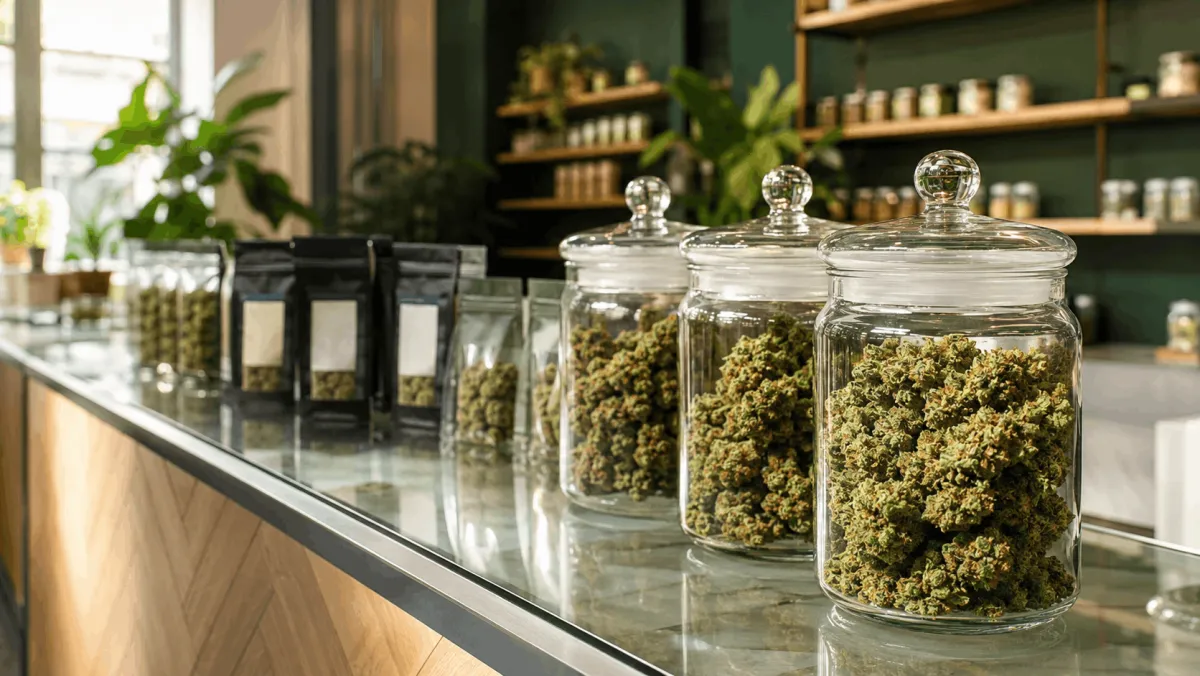
So: what is top shelf weed? It is a shelf position. It is a merchandising tier, invented by retailers to organize a menu and set price expectations, and it is not a grade that anyone certifies. This post is about what the tiers do and do not describe, where the price difference actually goes, and how to work out when the premium earns its keep.
TLDR - Quick Guide
- Top shelf is a merchandising label, not a regulated grade. California licenses and tests cannabis; it does not rank it.
- The tiers describe where a product sits in one retailer's price ladder. They travel badly between retailers.
- The premium mostly pays for cultivation method, hand labor, small batch size, packaging, and brand demand - in that rough order.
- Smalls are usually the same flower from the same batch, sorted by bud size. You lose the look, not the cure.
- The more processing between the flower and you, the less the premium delivers. Infusion erases it almost entirely.
- Discount days scramble the ladder. A top-shelf brand at 60% off routinely lands under a value brand at the standing rate.
- Compare final price per gram. Tier names and discount badges are both noise.
- The honest answer to whether it is worth it is: sometimes, for specific uses, and almost never for volume.
What the Tiers Actually Describe
A price ladder, written by the retailer
Top shelf, premium, exotic, private reserve, craft, mid, value, smalls. Those words come from retail merchandising, and their job is to help a shopper triangulate a price before reading a single detail about the product. They do that job well. They do nothing else.
No California regulation defines them. The Department of Cannabis Control licenses cultivators, distributors, and retailers, and requires batch testing before anything can be sold, but nothing in that framework assigns a quality grade. There is no board that reviewed the flower and put it on the top shelf. A category manager did, based on what it cost and what it will sell for.
Why the labels do not travel
Because the tier is defined relative to one menu, the same product can be top shelf at a retailer with a modest selection and mid at one with a deep one. Two shops using the same word are not making the same claim, and neither is making a claim you can check.
The practical consequence: a tier label is only useful for comparing products within a single menu on a single day. Across menus it means nothing at all.
What a tier definitely does not tell you
- Freshness. A top-shelf eighth that has been on the shelf for five months is an old eighth. The tier is assigned at intake and never updated.
- Cure quality. This is set by the producer and is entirely independent of price positioning.
- Whether you will like it. Terpene profiles are preferences, not rankings.
- Safety. That comes from mandatory testing, which every legal tier passes equally.
All four of those are things you can check yourself from the product. If you want the method, see our guide to assessing cannabis flower quality by sight, feel, and smell.
Where the Premium Actually Goes
The real cost drivers
A higher price is not arbitrary. It reflects production choices, and it is worth knowing which ones, because some of them show up in the flower and some of them show up only on the shelf.
- Cultivation method. Fully indoor growing carries a large, continuous power and climate-control bill that sun-grown and light-deprivation greenhouse cultivation do not. This is usually the single biggest line item behind an indoor premium.
- Hand labor. Hand trimming is slow and skilled. A machine trims in minutes what a person takes hours to do. You can see the difference in the buds, and you pay for it.
- Batch size. Small runs cannot spread fixed costs - testing, compliance, packaging design, distribution - across much volume. A small-batch eighth carries a larger share of each.
- Selection work. Running many phenotypes to find and keep the best expression of a cultivar costs seasons of grow space that produce nothing sellable.
- Packaging. Glass, custom printing, and inserts are real money and contribute nothing to the flower.
- Brand demand. When a name sells out reliably, its price rises to meet that. This is the portion of the premium with no production cost behind it at all.
The first four generally reach you as a better product. The last two generally do not. Any premium is some mix, and the mix is not disclosed anywhere.
Diminishing returns are steep
The distance between poorly grown flower and competently grown flower is enormous and obvious. The distance between competently grown flower and exceptionally grown flower is real but much smaller, and the price gap between those two is often larger than the gap between the first two.
This is the core of the value question. You are usually not choosing between bad and good. You are choosing between good and slightly better, at a price step sized as though it were bad and good.
Smalls: The Cheapest Honest Trick on the Menu
What they are
During processing, buds get sorted by size. The large, photogenic tops become the flagship product. The smaller buds from lower on the same plant, from the same harvest and the same cure, get bagged separately and sold as smalls, littles, or popcorn.
That is the whole story. Same genetics, same grow, same dry, same cure, smaller pieces, lower price.
What you give up and what you keep
- You give up bag appeal. Smalls look less impressive. If that matters to you, it matters, and there is no argument against it.
- You may give up some resin density. Buds lower in the canopy get less light and can carry slightly less resin. In a well-run grow the gap is smaller than the price gap.
- You may get a little more sugar leaf, since smaller buds are harder to trim cleanly.
- You keep the genetics, the cure, and the terpene profile. These are set at the batch level, not the bud level.
If you grind everything you smoke, the appearance you are paying a premium for is destroyed in the first two seconds of use. Smalls are the most straightforward way to cut cost without cutting quality, and they are underbought almost everywhere.
One caution: not every brand sources smalls from the same batch as its flagship. Some do, some pool from several runs. Judge the bag on the same physical evidence you would use for anything else.
When the Premium Is Worth Paying
It scales with how little you process the flower
This is the most useful rule in the whole question, and it is rarely stated. The value of premium flower tracks how much of it actually reaches your senses.
- Dry-herb vaporizer at a moderate temperature - the premium delivers most. You are volatilizing aromatic compounds without burning them, so terpene expression and cure quality are directly perceptible. This is where good flower is most obviously good.
- A joint or a pipe - the premium partly delivers. Combustion destroys a lot of aromatic detail, but a clean cure still reads in the smoothness and the first few draws.
- A large water pipe, or flower mixed into anything - the premium mostly disappears. Volume and dilution flatten the differences you paid for.
- Infusion into butter, oil, or capsules - the premium is gone entirely. Decarboxylation drives off the aromatics and you are extracting cannabinoids, which the cheapest compliant flower on the menu also contains. Buying top shelf to make edibles is the clearest waste of money in cannabis retail.
Other cases where it earns its keep
- You smoke small amounts slowly. If an eighth lasts you three weeks, the premium spread out over that time is a small weekly number for a noticeably better experience every session.
- You are buying for a specific occasion. Treating it as an occasional purchase rather than a baseline is a coherent choice.
- You are hunting a specific terpene profile that only a careful producer preserves. Some cultivars genuinely fall apart under mass production.
When the Same Money Is Better Spent Elsewhere
- You go through volume. The premium multiplies with quantity while the perceived improvement does not. This is the single most common way people overspend.
- You grind and roll everything. You are paying for structure and appearance you immediately destroy. Buy smalls.
- You are making edibles or infusions. See above. Buy the cheapest compliant flower, or better, buy actual edibles.
- You mostly want potency per dollar. Concentrates and cartridges deliver that far more efficiently than any tier of flower, and the tier ladder does not apply to them the same way.
- You cannot reliably tell the difference in a blind comparison. This is worth testing on yourself once. Buy one premium eighth and one mid eighth of similar cultivars, use them in alternating sessions for a week, and see whether you can pick them apart. Some people can, clearly. Some people cannot, and that is extremely useful information about where your money should go.
The substitution to actually run
Do not compare a premium eighth to a value eighth. Compare a premium eighth to everything the difference could buy instead: a larger quantity of good mid-tier flower, or a mid-tier eighth plus a cartridge, or a mid-tier eighth plus edibles that will last a month. Framed that way, the premium is competing against a much stronger field than the shelf next to it.
Discounts Break the Tier Ladder Entirely
Tier pricing assumes a stable list price. On a menu with a standing storewide reduction and a different set of brands discounted each day, that assumption fails constantly.
A top-shelf brand on its 60% day frequently lands below a value-tier brand sitting at the standing rate. When that happens, the tier label is actively misleading - it tells you the product is expensive on a day when it is not. Percentage badges are just as bad in the other direction, because a large percentage off a large number is not necessarily a small number.
The only comparison that survives is final price per gram, after every discount, on the day you are actually buying. Everything else is a proxy that breaks. For how the arithmetic works once tax and the delivery threshold are included, see what you actually pay on a cannabis delivery order, and for which brands are discounted on which day, see our guide to the weekly deal rotation.
Four Things You Should Refuse to Pay For
- The container. Heavy glass and a magnetic lid have never improved flower.
- The THC number. Potency is a legitimate data point and a terrible price justification. A three-point difference in a lab number is not a three-point difference in your evening.
- Scarcity language. Limited drop, small batch, and one-time release describe supply, not quality.
- The strain name. A famous cultivar name tells you about genetics, which are potential. Two producers growing the same cultivar can deliver very different flower.
Key Takeaways
- Top shelf is a retail tier, not a regulated grade. California requires testing and licensing but does not rank quality.
- Tier labels are only meaningful within one menu on one day, and are worthless for comparing across retailers.
- The premium pays for indoor cultivation, hand trim, small batch size, and selection work, plus packaging and brand demand that reach you as nothing.
- Returns diminish sharply. The gap between good and excellent is much smaller than the gap between bad and good, and usually costs more.
- Smalls are typically the same flower sorted by size. If you grind it, you are paying for an appearance you are about to destroy.
- The premium is most worth it in a dry-herb vaporizer and completely wasted in infusions.
- Deep discount days routinely put top-shelf brands below value brands, so compare final price per gram rather than tier names or percentage badges.
- Test yourself once with a blind comparison. The result tells you more about your budget than any menu description will.
FAQs
1. What is top shelf weed, exactly?
It is a merchandising tier a retailer uses to mark the upper end of its own price ladder. The name comes from the retail habit of putting the most desirable stock at eye level or above. It is not a certification, no California regulation defines it, and no independent body assigns it. Two retailers can apply the label to very different flower, which is why it only helps you compare products inside a single menu.
2. Are smalls lower quality than regular flower?
Usually not in the ways that matter. Smalls are generally the smaller buds sorted out of the same harvest and the same cure as a brand's flagship product, so the genetics, terpene profile, and cure are the same. What differs is size and appearance, and sometimes a little resin density, since lower-canopy buds receive less light. If you grind your flower, smalls are the most direct saving available on a cannabis menu.
3. Is expensive weed actually better?
It is often somewhat better, and rarely better in proportion to the price. Some of the premium buys real production quality - indoor climate control, hand trimming, small batches - and some buys packaging and brand demand that never reach the flower. The improvement is also subject to steep diminishing returns, so the step from mid to top shelf is a much smaller experiential change than the step from poor to mid, at a larger price.
4. When should I not buy premium flower?
When you are buying volume, when you grind and roll everything, when you are infusing it into edibles or oil, and when you mainly want potency per dollar. Infusion is the clearest case: decarboxylation drives off the aromatic compounds the premium paid for, leaving cannabinoids that the cheapest compliant flower also has. In that use, top shelf and value flower produce nearly the same result.
5. How do I compare prices when everything is discounted?
Ignore both the tier label and the discount percentage and work out the final price per gram on the day you are buying. A large percentage off an expensive product can still cost more than a modest discount on a comparable one, and on a deep discount day a top-shelf brand often lands below a value brand. Current pricing is on the MedLeaf menu, where the discount is already reflected in the price shown.
More from September 2026
Order weed delivery near you
MedLeaf delivers licensed, lab-tested cannabis across North County San Diego and Southwest Riverside County. Pick your city to see local delivery details, or browse the live menu.
- Weed delivery in Oceanside
- Weed delivery in Carlsbad
- Weed delivery in Encinitas
- Weed delivery in San Marcos
- Weed delivery in Vista
- Weed delivery in Escondido
- Weed delivery in Fallbrook
- Weed delivery in Bonsall
- Weed delivery in Temecula
- Weed delivery in Murrieta
- Weed delivery in Solana Beach
- Weed delivery in Del Mar
- Weed delivery in Poway